People who carry extra weight around the waist tend to be at higher risk of certain health conditions than people who carry extra weight around the hips. Your waist-to-hip ratio (WHR) is a simple way to get a sense of how your body stores fat.
To find your WHR, measure your waist circumference and your hip circumference in the same units and divide the waist measurement by the hip measurement. The result can help you understand your general body shape and whether it may be worth talking to a health professional about your weight.
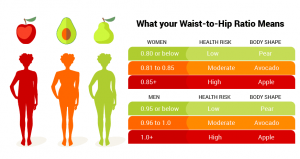
In general, a higher WHR points to an “apple” shape, with more weight carried around the waist, while a lower WHR points to a “pear” shape, with more weight carried around the hips. A pear shape is generally associated with lower health risk.
What Is the Waist-to-Hip Ratio?
The waist-to-hip ratio is a dimensionless ratio of waist circumference to hip circumference. You can calculate it by dividing your waist measurement by your hip measurement.
For example, someone with a 76 cm (30-inch) waist and 97 cm (38-inch) hips has a waist-to-hip ratio of about 0.79.
WHR is often used as one indicator of health and of the possible risk of developing certain conditions. It has also been studied in relation to fertility, with different typical values for women and men.
WHR Health-Risk Chart
The figures below are based on World Health Organization (WHO) guidance and are general reference points, not a diagnosis:
| Sex | Lower risk | Increased (abdominal obesity) risk |
|---|---|---|
| Women | 0.80 or below | Above 0.85 |
| Men | 0.90 or below | Above 0.90 |
How to Calculate Your Waist-to-Hip Ratio
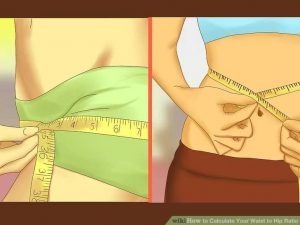
According to the WHO protocol, measure your waist circumference at the midpoint between the lower margin of the last palpable rib and the top of the iliac crest, using a stretch-resistant tape held at a constant tension of about 90-100 g. Measure your hip circumference at the widest part of your buttocks, keeping the tape parallel to the floor.
Other organizations, such as the National Health and Nutrition Examination Survey and the National Institutes of Health, use slightly different reference points, often measuring from the top of the iliac crest. Many people measure the waist at the navel, but this can underestimate the true waist circumference.
For an accurate reading, follow these tips:
- Stand with your feet together and arms at your sides, with your weight evenly distributed.
- Wear minimal clothing and stay relaxed.
- Take the measurement during normal, relaxed breathing.
- Repeat the measurement twice. If the two readings differ by less than 1 cm, use the average; if they differ by more than 1 cm, measure again.
To get your ratio, divide your waist measurement by your hip measurement. For example, a 32-inch (81.4 cm) waist and a 42-inch (106.6 cm) hip give 81.4 / 106.6 = about 0.76. As a general guide, a WHR around 0.86 or higher in women, and around 0.95 or higher in men, is associated with greater health risk.
Practical Measurement
 Source: http://www.wikihow.com/
In everyday terms, measure your waist around the smallest part of your natural waistline, usually just above the belly button, and measure your hips around the widest part of your hips and buttocks. If your midsection is convex rather than concave, for example during pregnancy or with certain body types, take the waist measurement on a horizontal line 1 to 2 inches above the navel.
What WHR Can Tell You About Health
WHR is used as one indicator of health and of the possible risk of developing certain conditions. People with apple-shaped bodies carry more weight around the waist and, on average, tend to face higher health risks than people with pear-shaped bodies, who carry more weight on the hips.
WHR is also used as one measure of obesity. According to the WHO, abdominal obesity is defined as a waist-to-hip ratio above 0.85 for women and above 0.90 for men, or a BMI above 30.0. According to the National Institute of Diabetes and Digestive and Kidney Diseases, women with a WHR of 0.80 or above and men with a WHR of 1.0 or above may be more likely to develop health problems linked to fat distribution.
WHR can be a useful predictor of mortality in older adults (around age 75 and over), sometimes more so than BMI or waist circumference alone. Some research suggests that defining obesity by WHR rather than BMI can substantially increase the number of people identified as being at risk of heart attack. Measuring body-fat percentage is generally a more precise way to assess relative weight.
One advantage of WHR is that it can distinguish between body shapes that other measures miss: two people can share the same WHR but have different BMIs, or have different WHRs but the same BMI. Some studies suggest WHR may predict cardiovascular disease better than BMI or waist circumference, while other studies highlight waist circumference as a good indicator of heart disease, high blood pressure in people with type 2 diabetes, and overall body-fat distribution.
Estimated Body Shapes and Health Risk
1. The Apple Shape – Higher Health Risk
If you are apple-shaped, you tend to carry more weight in the upper torso, waist, and abdominal area. On average, people who are apple-shaped face a higher risk of heart disease and diabetes.
2. The Pear Shape – Lower Health Risk
People who are pear-shaped carry more weight in the thighs and buttocks. Storing fat in the lower body has been associated with a lower risk of cardiovascular disease and atherosclerosis.
Possible Links to Health Conditions
1. Type 2 Diabetes
Women with a WHR around the 0.7 range appear, on average, to be less likely to develop type 2 diabetes.
2. Cardiovascular Disease
One study found that WHR may be more effective than BMI or waist circumference at predicting cardiovascular disease.
3. Fertility
According to one study, women with a WHR above 0.80 had lower pregnancy rates than women with a lower WHR.
Advantages and Limitations of the WHR Calculator
The waist-to-hip ratio has some useful benefits, but also some clear limitations:
- Advantage: It is an inexpensive and easy way to get a general sense of body-fat distribution.
- Limitation: It is not reliable for pregnant women, since the waist expands as the baby develops.
- Limitation: It may give misleading results for people who have recently had liposuction of the hips or waist.
- Limitation: It can be less accurate right after a meal, because food and liquid in the stomach can temporarily increase waist circumference.
- Limitation: It does not directly measure abdominal fat mass; it reflects abdominal fat in relation to lower-body size.
How to Work Toward a Healthier WHR
A healthy WHR often reflects a balanced diet and regular exercise. If your results suggest you are underweight, focus on nutritious, nutrient-dense foods rather than highly processed “fattening” foods. If you are overweight, you may be at higher risk of conditions such as type 2 diabetes, osteoarthritis, heart disease, and high blood pressure, so it is worth taking steps to manage your weight.
This article is for general information only and is not medical advice. Before starting a new diet or exercise program, or if you have concerns about your weight or health risk, please consult a qualified healthcare professional.
1. Healthy Lifestyle
Try to limit excess calories and sugary foods, and go easy on fatty foods, to support a healthier body-fat percentage and waist-to-hip ratio over time. A balanced diet can help with weight management. Helpful habits include:
- Eat reasonable portions and enjoy regular meals: breakfast, lunch, and dinner.
- Include plenty of fruits, vegetables, and fiber, and choose quality carbohydrates from vegetables, fruits, and lean proteins.
- Add sources of omega-3 fatty acids, such as salmon, swordfish, canola oil, and walnuts.
- Avoid late-night meals, and choose snacks like nuts instead of chips.
2. Relaxation
Ongoing stress and anxiety can raise levels of the hormone cortisol, which may contribute to fat storage around the middle. Finding ways to reduce stress, such as yoga, meditation, or breathing exercises, may help support a healthier midsection as part of an overall healthy lifestyle.
6 Abdominal Exercises
1. Planks
 Source: http://www.womensdietnetwork.com/
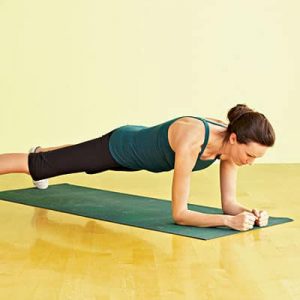
Start in a push-up position, but rest your elbows on the floor. Keep your torso and knees in a straight line with your body, and keep your head relaxed while looking down at the floor. Hold, then take a short break of about 10 seconds before starting again.
2. Side Leg Raises
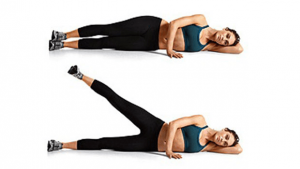 Source: http://community.tribesports.com/
Lie on one side with your arm stretched out to support your head. Place your other arm in front of your body with the palm facing down. Straighten your legs and lift your top leg as high as you comfortably can, then lower it back to the starting position.
3. Weighted Sit-up
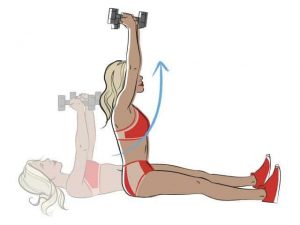 Source: http://www.womenshealthmag.co.uk/
Lie on the floor and hold a weighted plate over your chest. Bend your knees at a 90-degree angle with your feet flat on the floor. Keep your chin toward your chest and sit all the way up.
4. Star Plank
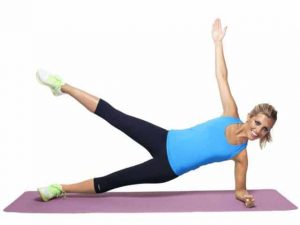 Source: http://www.womenshealthmag.co.uk/
Hold yourself in a push-up position, then move your arms and legs as far apart as possible so your body forms a star shape. Hold for about 30 seconds with your abs braced and your torso straight.
5. Sit-up and Throw
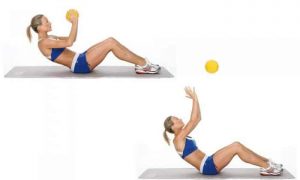 Source: http://www.womensfitness.co.uk/
Sit on the floor and hold a medicine ball in front of your chest with both hands. Anchor your feet under something sturdy. Lie back away from a wall, then explosively sit up and throw the ball toward the wall, catching it as it bounces back to you.
6. Sprinter
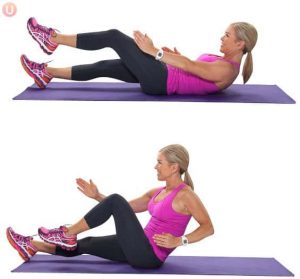 Source: http://gethealthyu.com/
Place your feet in foot cradles and hold a push-up position with your hands on the floor. Drive one knee toward your chest while keeping the other leg extended, then switch legs. Continue alternating as if you were running in place.